 The Blenny Guide
(Valenciennes 1836)

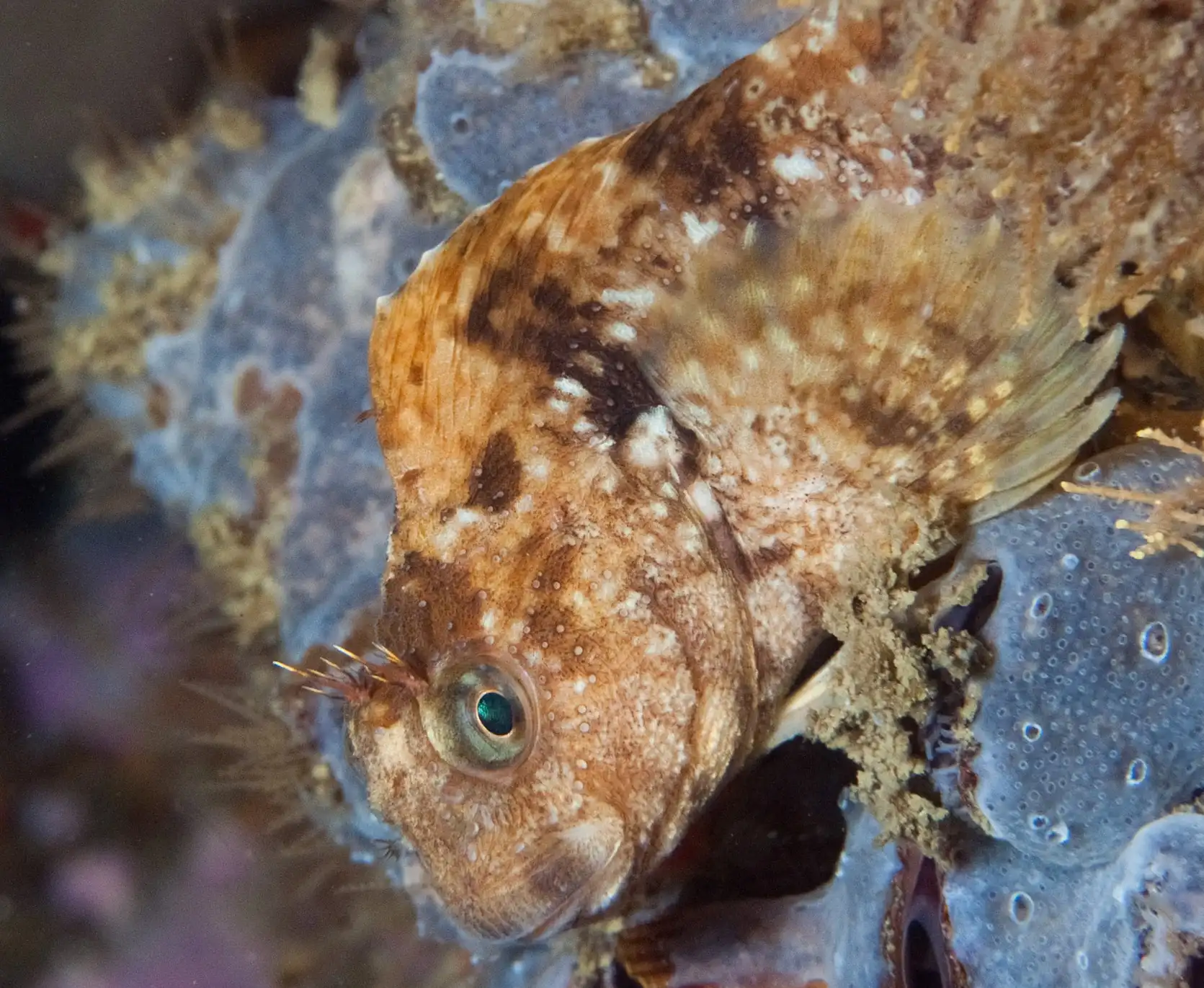
Orbital cirri heavily branched and ~length of eye diameter. Short nasal cirri. Skin wrinkly. 2 lines of sensory pores running down the first half of the upper body.
Colour highly variable. Can be black and plain or any shade of brown and patterned. Patterned individuals with 6 bands with get thicker posteriorly. Last band is at the end of the caudal fin and thinner than the previous. Bands can be faint, especially the rear ones. Often white between blotches on upper and lower sides. Dark blotch on upper head behind eyes. Rear of head can have white spots/blotches. Pectoral fin with dark and light brown mottling. Dorsal fin same colour and patterns as body.
Reaches SL 20.0 cm / 7.9 in.
Rocky substrate, corals and sponges. Often found hiding in crevices, large holes and gaps and between coral.
8 - 10 m / 26 - 33 ft.


No morphological information yet, data is being added...
International Union for Conservation of Nature 2014. Chalaroderma capito. The IUCN Red List of Threatened Species. Version 2025-2. Accessed on 10 June 2026.
https://www.iucnredlist.org/
Williams, J.T. 2014. Chalaroderma capito. The IUCN Red List of Threatened Species 2014: e.T48342244A48400506. Accessed on 10 June 2026.
https://dx.doi.org/10.2305/IUCN.UK.2014-3.RLTS.T48342244A48400506.en
Smith, J. L. B., Heemstra, P. C., & Smith, M. M. (1986). Smiths' Sea fishes. Macmillan South Africa.
https://www.biodiversitylibrary.org/page/58102213