 The Blenny Guide
Linnaeus 1758

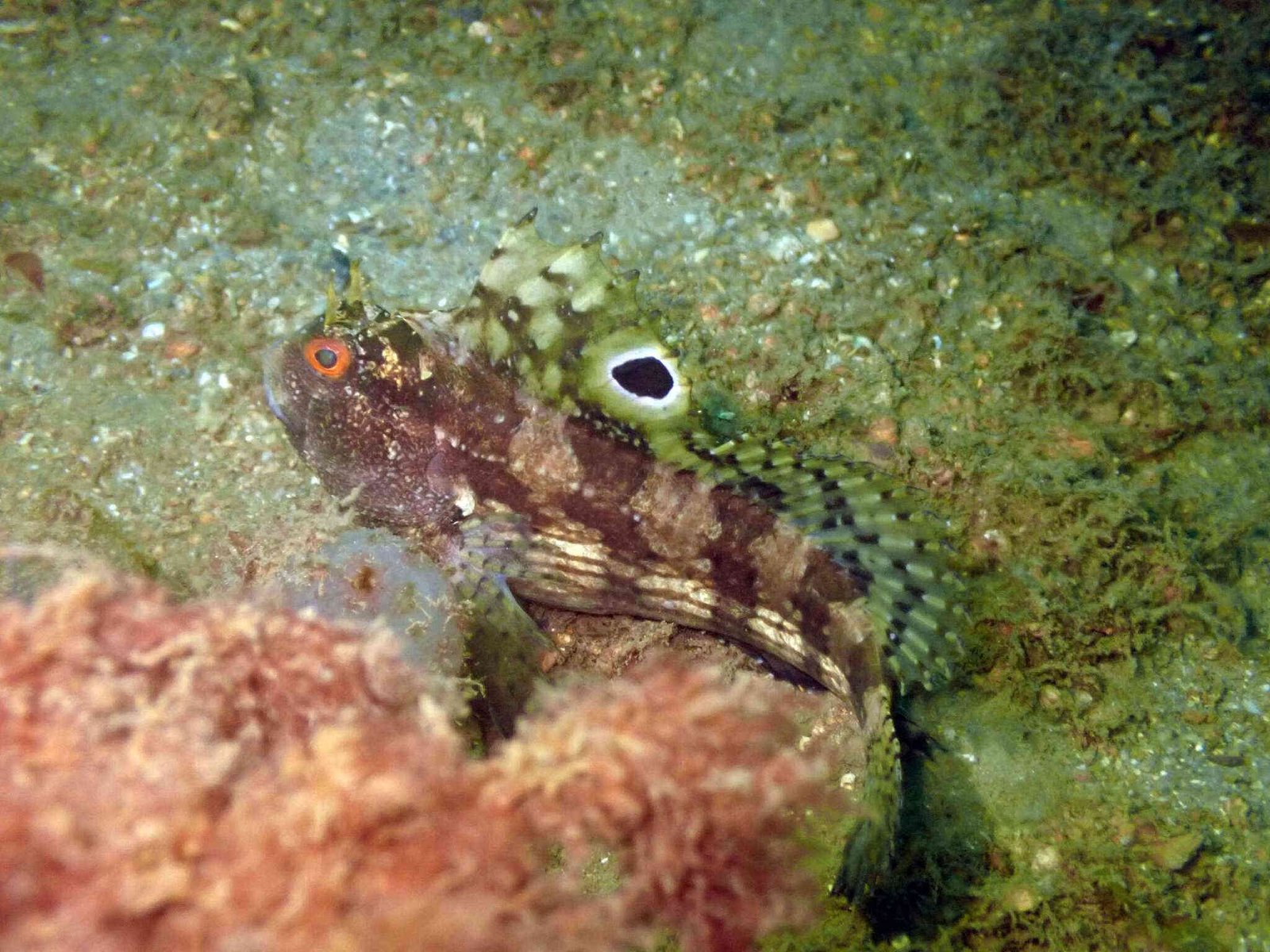
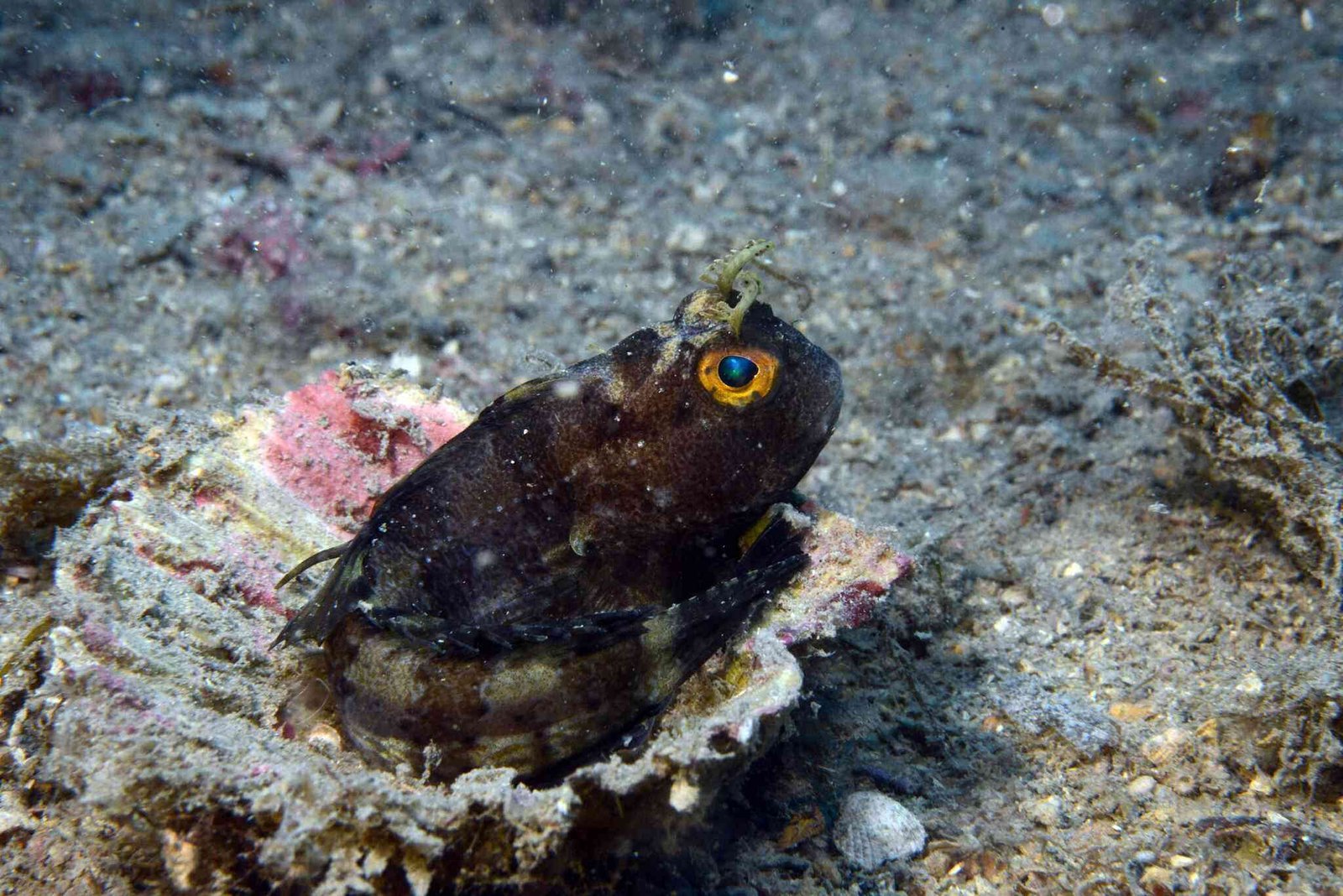
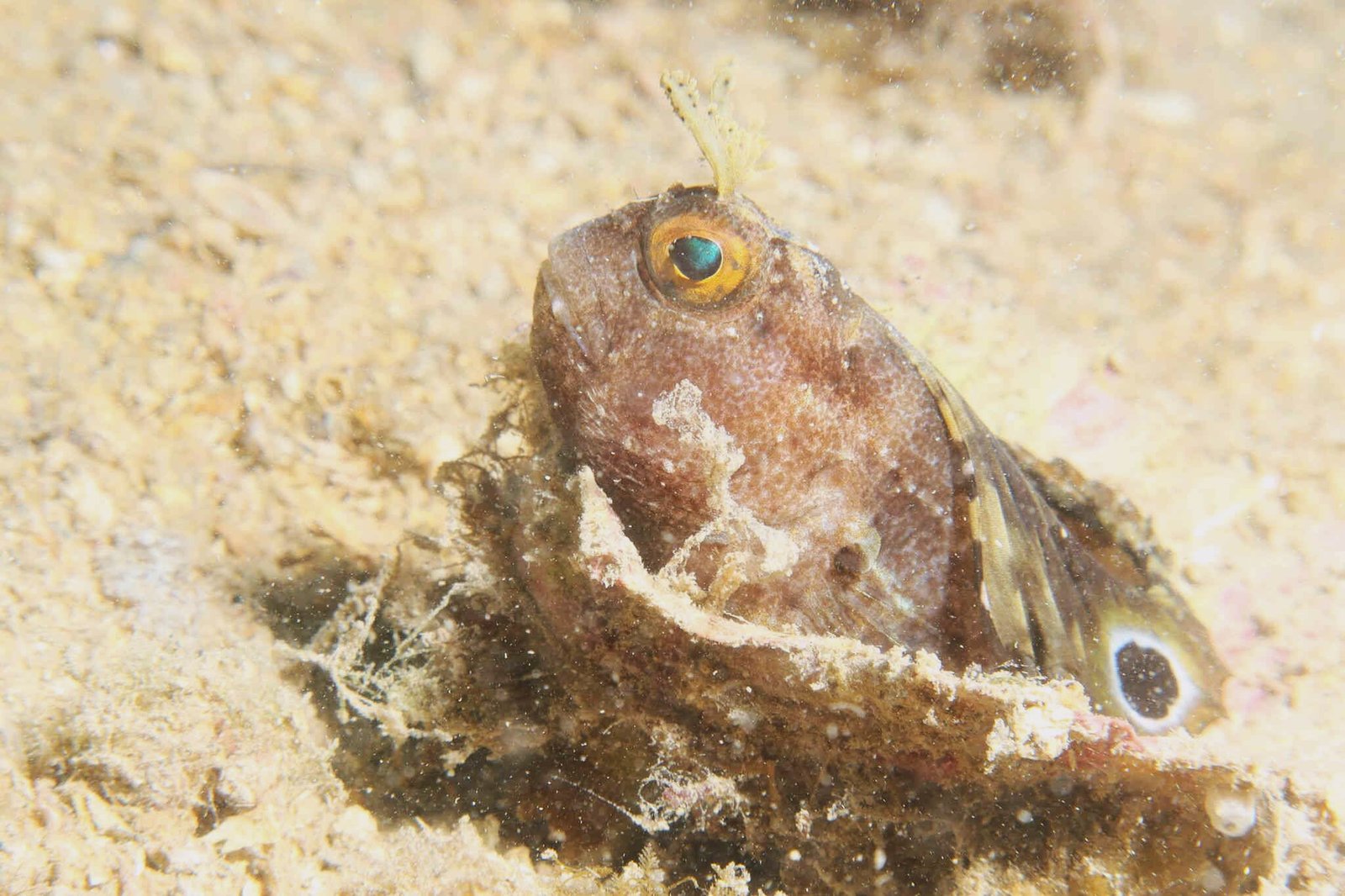
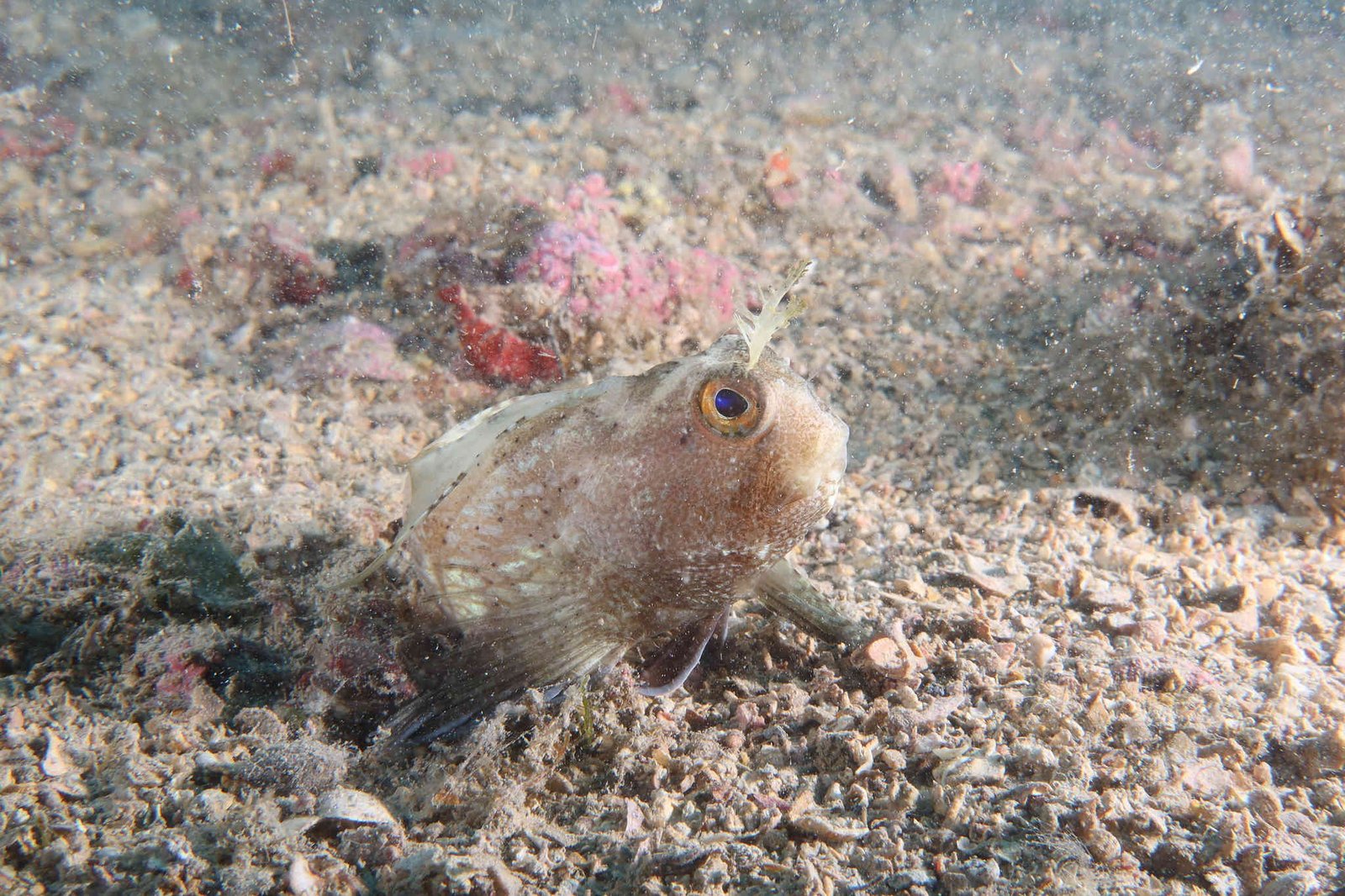
large head and front of body which tapers off. Front of dorsal fin tall with a notch halfway, spines continue past membrane with filamentous extensions. Feather-like orbital cirri. Short, simple nasal and nape cirri.
Juveniles: dorsal fin short, spines do not extend. Notch still present.
Adults: dark brown with a darker head and ~5 bands along body. Belly is cream. White speckles on head. Green dorsal fin. Rows of black and white on dorsal spines. White-ringed black ocellus between spines V-VIII.
Young adults: light tan with fainter bands. Dark line below eye to lower lip. Dorsal ocellus can be absent.
Juveniles: white or very light brown. Lighter on top of head. Black line below eye and on front of head. No dorsal ocellus. Dorsal fin white.
Reaches TL 20.0 cm / 7.9 in.
Soft and hard bottoms, ranging from sand, silty mud and rubble with coarse sand.
10 - 400 m / 33 - 1312 ft.

No morphological information yet, data is being added...
International Union for Conservation of Nature 2014. Blennius ocellaris. The IUCN Red List of Threatened Species. Version 2025-2. Accessed on 09 June 2026.
https://www.iucnredlist.org/
GBIF.org (09 June 2026) GBIF Occurrence Download
https://doi.org/10.15468/dl.8rneuw
Antonio Di Natale, Murat Bilecenoglu, Michel Bariche, Can Bizsel, Enric Massuti, Jeffrey Williams, Matthew Craig. 2014. Blennius ocellaris. The IUCN Red List of Threatened Species 2014: e.T185126A1768546. Accessed on 09 June 2026.
https://dx.doi.org/10.2305/IUCN.UK.2014-3.RLTS.T185126A1768546.en
Bauchot, M.-L. (1987). Poissons osseux. In W. Fischer, M. L. Bauchot, & M. Schneider (Eds.), Fiches FAO d'identification pour les besoins de la pêche: Méditerranée et mer Noire. Zone de pêche 37 (Rev. 1, Vol. 2, pp. 983-990). Commission des Communautés Européennes; FAO.
https://openknowledge.fao.org/handle/20.500.14283/x0170f