 The Blenny Guide
(Günther 1861)

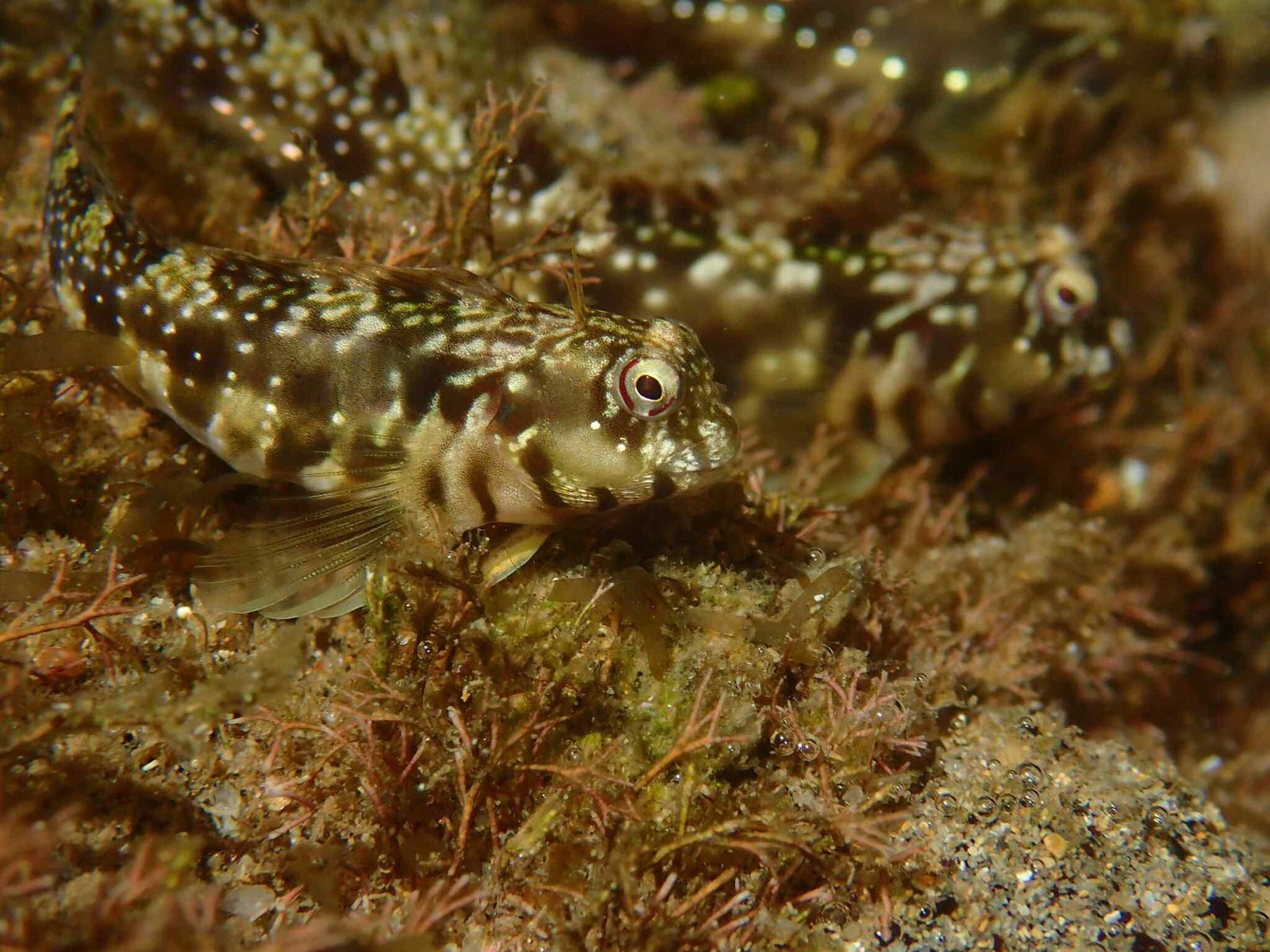
No orbital cirri. Short, simple nasal cirri. Elongated nape cirri, from 1-2x the length of the eye diameter.
Light to dark brown, can have green hues. Iris with incomplete purplish-red rings along the outer edge. Thick black bands on throat and pectoral fin base. Broken white lines below eye and on lips. ~7 dark bands along body, vary in height from spanning entire height to being only at midflank. Between bands paler. Belly pale. Upper body and head with white blotches. White dots along body.
Reaches TL 7.5 cm / 3.0 in.
Shallow areas, can be found on corals, sandy bottoms, rocks or rubble.
0 - 37 m / 0 - 121 ft.




No morphological information yet, data is being added...
International Union for Conservation of Nature 2014. Antennablennius bifilum. The IUCN Red List of Threatened Species. Version 2025-2. Accessed on 27 May 2026.
https://www.iucnredlist.org/
GBIF.org (27 May 2026) GBIF Occurrence Download
https://doi.org/10.15468/dl.t59yt5
Smithsonian Institution, National Museum of Natural History, Division of Fishes, USNM 341904 specimen record
http://n2t.net/ark:/65665/30574cbf7-6bdd-4dda-9cb6-c194dd394746
Williams, J.T., Smith-Vaniz, W.F. & Hastings, P.A. 2014. Antennablennius bifilum. The IUCN Red List of Threatened Species 2014: e.T46079226A46664364. Accessed on 29 May 2026.
https://dx.doi.org/10.2305/IUCN.UK.2014-3.RLTS.T46079226A46664364.en
Springer, V. G. (1986). Blenniidae. In M. M. Smith & P. C. Heemstra (Eds.), Smiths' sea fishes (pp. 742-755). Springer-Verlag.